


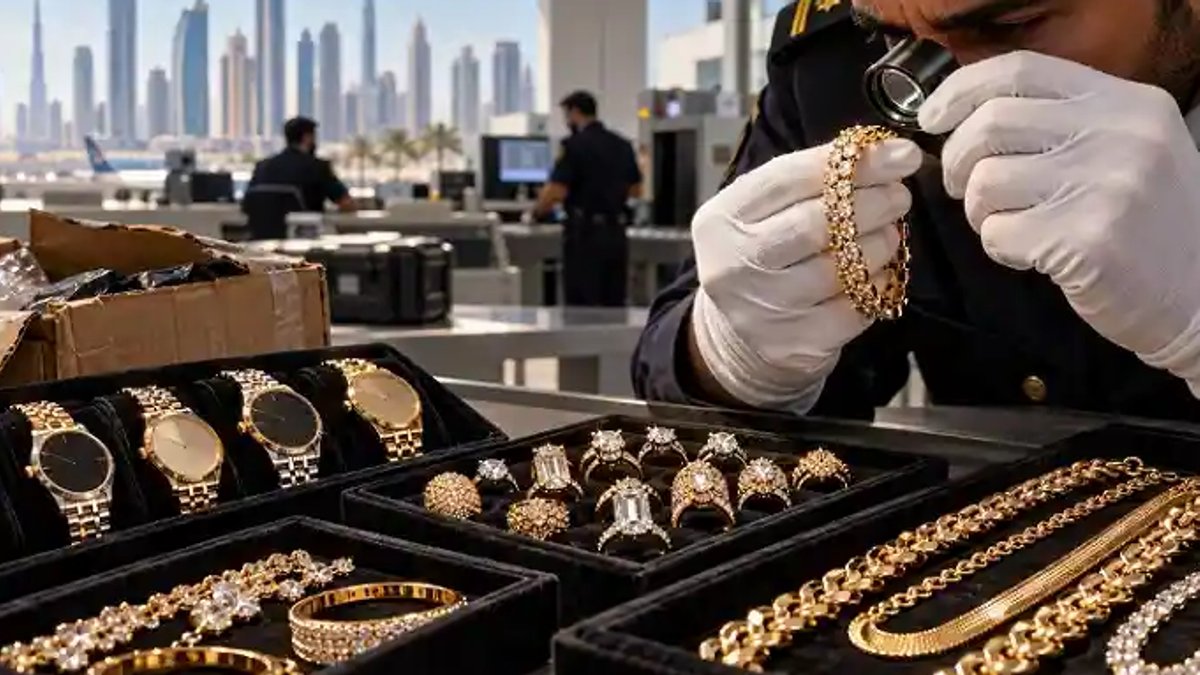
A $467 billion global trade in counterfeit goods strains customs agencies, particularly in the Middle East, where tracking fake jewelry and luxury watches through borders remains difficult. The issue persists despite enforcement efforts, as scattered records leave authorities unable to determine how much enters the region, where it originates, or which routes supply demand.
The OECD and European Union published a report in May 2025 estimating this figure based on 2021 data, covering only cross-border trade in fakes while excluding domestic sales and digital piracy. Even then, customs systems often group jewelry with watches, accessories, or leather goods, obscuring the true scale of the trade.
China and Hong Kong accounted for 84% of the estimated value of seized counterfeit Swiss watches during 2020 and 2021. Smaller shipments increase detection risks. In June 2026, U.S. customs in Louisville intercepted a Hong Kong package bound for New York containing 375 fake Audemars Piguet watches, with a genuine retail value exceeding $54 million. A month earlier, in Indianapolis, officers seized 875 counterfeit jewelry pieces and five handbags, Cartier, Tiffany & Co., and Van Cleef & Arpels, worth over $3.7 million if authentic.
These cases reveal a key challenge: counterfeit networks break shipments into individual orders, complicating efforts to identify patterns in high-volume delivery channels. The problem extends beyond physical goods. TikTok reported blocking over 40 million products before listing in early 2025 for intellectual property violations, then removing another 2 million after publication. The platform also deleted 143 million videos promoting counterfeit sales, alongside 530,000 creator videos tied to infringement.
Enforcement gaps in the Middle East worsen the situation. Dubai Customs recorded 285 seizures worth AED 92.695 million in 2024, but the data does not break down seizures by category, making it difficult to assess the full scale of the jewelry and watch trade. Morocco’s customs reported 896,000 goods suspended in 2025, valued at MAD 11.1 million, though these figures do not isolate jewelry or watches or clarify valuation methods. Egypt and Saudi Arabia have not released recent public figures separating counterfeit jewelry and watches from other goods, leaving a critical gap in regional analysis.
A Europol-backed operation in March 2024 linked counterfeit luxury watches to drug trafficking and money laundering. Across Belgium, Israel, the Netherlands, and Slovakia, authorities arrested 15 suspects, seizing 165 fake watches, 200 diamonds, €209,000 in cash, and 14 kilograms of drugs. The watches were assembled outside the EU using mixed genuine and counterfeit parts, then imported into Belgium for distribution.


