


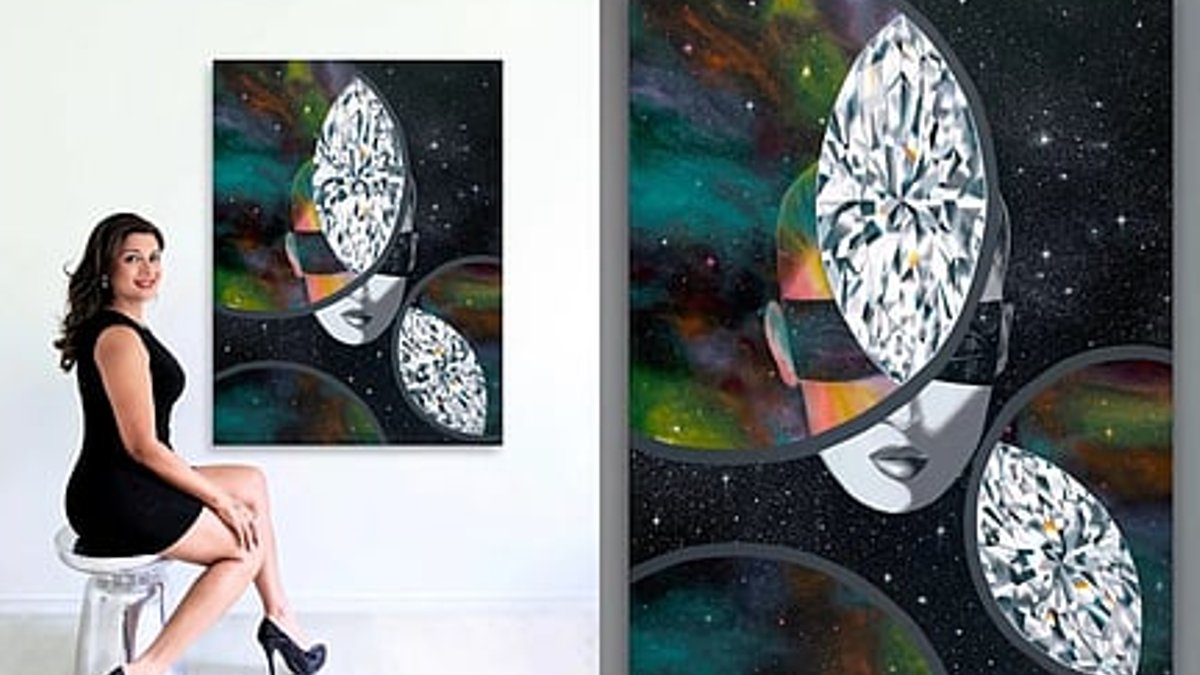
Can a human truly own a diamond, or is the purchase simply a temporary loan for an object that will outlast humanity? This is the central conflict of the Billion-Year Paradox, a concept explored by Canadian visual artist Reena Ahluwalia. The inquiry asks whether our fleeting lifespan, which spans roughly 90 years, can meaningfully relate to a gemstone that formed three billion years ago. In the 24-hour cycle of a single diamond, a human life lasts less than 0.0026 seconds—just forty times faster than a blink. This extreme disparity forces a re-evaluation of how we approach the purchase and preservation of these stones.
The Weight of Time
Reena Ahluwalia frames the dilemma using the myth of Ozymandias. The king built a massive stone statue to command the future, yet only the rubble remains in the desert. The tragedy was not the destruction of the stone, but the death of the story attached to it. Similarly, a diamond is the “constant” in a changing world, while the human is the “variable.” The paradox suggests that if an object outlasts us, the concept of “claiming” it is an impossibility. We do not want the story of today to become the forgotten king of tomorrow, which requires a shift in perspective.
Related: Behind the Seams: The Making of a Custom Wedding Gown
Stewardship Over Ownership
Traditional marketing strategies often fail because they treat an eternal medium within a short-term transactional cycle. The solution, according to Ahluwalia, lies in shifting from passive ownership to active stewardship. This approach is rooted in the 17th-century Vanitas movement, a tradition of memento mori that used symbols like skulls and wilting flowers to remind viewers of mortality. Dutch artists often paired these reminders with beautiful jewels, highlighting that while the person wears out, the stone remains. An object that embodies permanence has no competition against something as fleeting as life itself.
It is helpful to view this through the lens of geological time. James Hutton, an 18th-century geologist, observed “no vestige of a beginning, no prospect of an end” in Earth’s cycles. Ancient artists applied this same logic by anchoring human stories on geological constants, such as the cave paintings at Chauvet. This historical precedent shows that resilience comes from choosing a medium that can withstand the test of time. In the current era of deepfakes and digital instability, the diamond offers a tangible anchor for a generation seeking an authentic foothold.
Related: Lab Grown Diamonds Canada vs Diamond Alternatives: What Sets Them Apart
A Philosophical Prism
Reena Ahluwalia applies this framework through her “Luminist” approach. As a visual artist, she does not simply replicate the appearance of a diamond; she engages with it as a philosophical prism. Her work captures the internal frequency of human resilience, using the gemstone to study light as a medium of endurance. This practice treats the diamond as a physical record of survival under pressure, mirroring the human experience.
By integrating blockchain technology with diamond art, she attempts to secure a digital legacy for the stones. The result is a framework where the human story is tethered to the immutable. We never actually own the diamonds; we only borrow their forever.


