


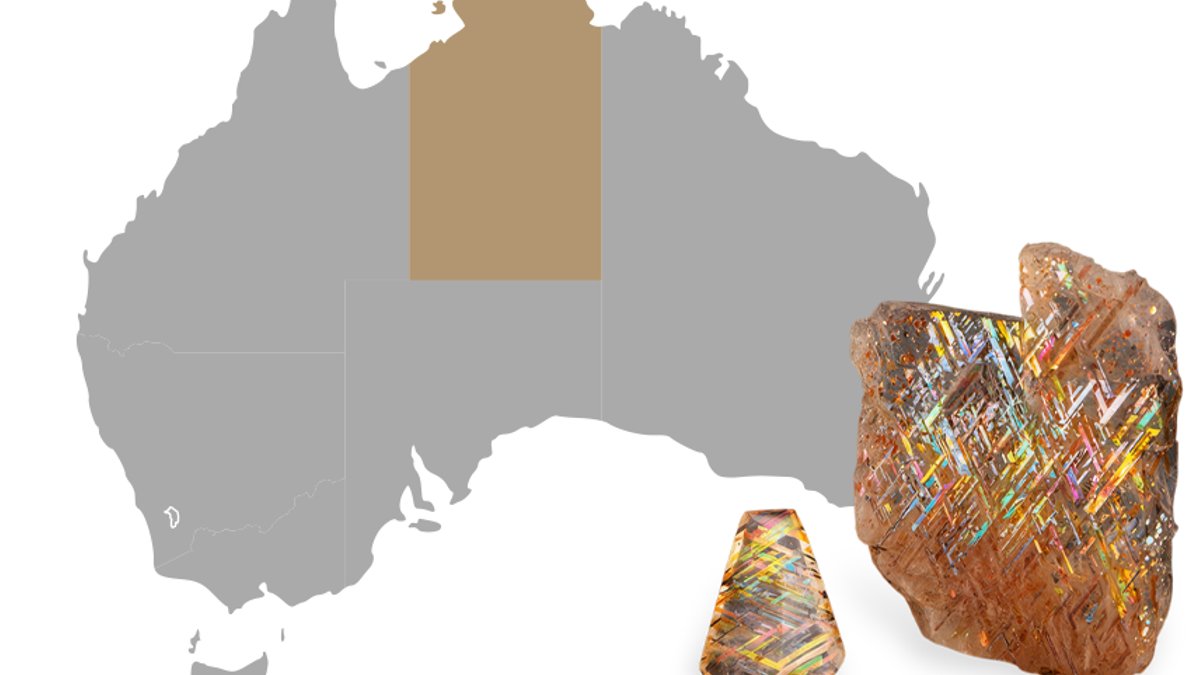
Some of the most significant discoveries are not visible above ground. They hide beneath the ancient rocks of the Red Centre, preserved for millions of years. Harts Range, east of Alice Springs, has quietly produced an extraordinary collection of gemstones for decades. Zircon, garnet, aquamarine, ruby, chrysoberyl, tourmaline, kyanite, moonstone and smoky quartz have all emerged from its pegmatites and metamorphic rocks. Unlike many famous localities known for a single signature stone, Harts Range rarely tells the same story twice.
Every find adds another piece to its geological puzzle. In 1985, the story took an unexpected turn near Kong Bore. Darren Arthur and Sonny Mason recovered a gemstone unlike anything previously documented. Four years later, the Gemological Institute of America introduced Rainbow Lattice Sunstone to the gemmological world as a completely new material. More than forty years later, it remains unique to this small corner of the Northern Territory.
A Geometry of Light
Rainbow Lattice Sunstone is fascinating for another reason. Unlike sunstones from Norway, Sweden and Oregon, admired for their warm colours and aventurescence, the Kong Bore material displays a striking geometric lattice. The effect is created by microscopic inclusions of hematite and magnetite arranged with extraordinary precision. Golden flashes, iridescent colours and delicate lattice patterns appear and disappear as the stone moves through the light. This gives every specimen its own character.
Remarkably, the gemstone is still revealing its secrets. Scientists continue to study its mineralogy more than four decades after its discovery. Originally described as a mixture of orthoclase and albite, more recent investigations suggest that some material may instead be microcline-rich. This highlights that this unusual Australian gemstone is still not fully understood. That combination of rarity, beauty and ongoing scientific interest is unusual in the gem world.
The material is a moonstone, which is a microcline feldspar. According to textbooks, moonstone is generally around 75 per cent orthoclase and 25 per cent albite. The Harts Range material is generally around 90 per cent orthoclase and 10 per cent albite. It is perhaps no surprise that the exact locality has never been publicly disclosed. The mine owners have deliberately protected the deposit, recognising how easily such a unique occurrence could be depleted. Originally, a mining claim was placed on the deposit in the 1990s, but it lapsed. Since the area was placed under a mining lease in 2019, opportunities to fossick for Rainbow Lattice Sunstone have become increasingly limited.
Related Post: JGW September Highlights Rare Gems, Bold Designs, Programme
Diversity in the Red Dust
Harts Range should never be remembered for only one gemstone. The district continues to produce some of Australia’s finest zircon, with colours ranging from colourless and champagne to honey, amber, highly prized pink and rich reddish-brown. Almandine and rhodolite garnets, aquamarine, chrysoberyl, tourmaline, kyanite, golden beryl and hessonite all contribute to a diversity rarely matched by any other Australian gem locality. This variety is perhaps the district’s greatest strength. It rewards curiosity.
One visit might uncover a beautifully coloured zircon, another an elegant garnet crystal, while the possibility of discovering something completely unexpected has always been part of its appeal. Today, declared fossicking areas, including Harts Range West, Central Harts Range and the Mud Tank Zircon Field, attract enthusiasts from across Australia and from overseas. For many, finding a first zircon or garnet becomes far more than a souvenir. It becomes the beginning of a lifelong fascination with Australian gemstones.
Australia’s gemstone story is often told through opal and sapphire, yet Harts Range reminds us there are still remarkable chapters waiting to be discovered. Hidden beneath the rocks of the Red Centre lies a geological treasure unlike any other, where scientific curiosity, natural beauty and the thrill of discovery continue to meet. » Learn About Gemstones » Study Gemmology » Find a Gemmologist » Join the GAA www.gem.org.au Like this article?
Polish your gemstone knowledge online From lapis lazuli and coloured diamonds to synthetic moissanite and zebra rock, brush up on your gemstone knowledge. The Gemmological Association of Australia (GAA) has over 14 years of gemmology articles freely available to read online on Jewellermagazine.com under Learn About Gemstones . Interested in taking your gemstone knowledge to another level? Explore courses with the GAA on gem.org.au READ EMAG


