


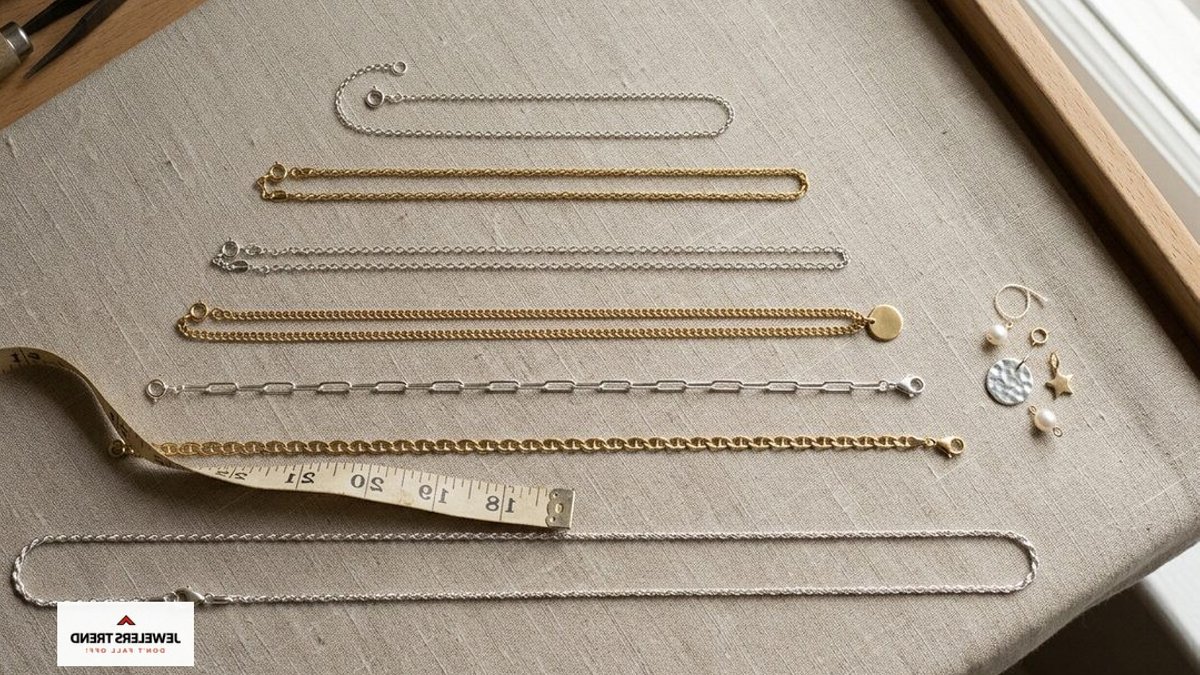
A necklace’s length goes beyond a simple measurement on a tag. The six standard categories—collar, choker, princess, matinee, opera, and rope—dictate placement on the body, interaction with necklines, and whether the piece makes a bold statement or remains understated. The difference between a 14-inch choker and a 16-inch version may seem minor, but shifting to a 28-inch opera or a 36-inch rope completely alters how the jewelry appears.
Industry standards measure necklaces from clasp to tip, including the clasp. A collar (12–13 inches) sits near the throat, almost like an additional layer, while a choker (14–16 inches) rests at the neck’s base, framing rather than competing with an open neckline. Both work best when the intention is to direct attention upward. To verify fit before purchasing, lay the necklace flat and measure from end to end, or wrap a tailor’s tape around the neck for a preview.
The princess length (17–19 inches) remains the most popular because it settles at or just below the collarbone, complementing most pendants and necklines. It serves as the standard for many finished designs. Dropping to a matinee (20–24 inches) positions the necklace between the collarbone and bust, allowing pendants to stand out—ideal for daytime or office settings. Opera lengths (28–36 inches) extend to the bustline or lower, functioning as a single strand or doubled for layered effects. Any length beyond 36 inches qualifies as a rope, offering flexibility to knot, loop, or divide into multiple tiers.
Read Also: Diamond Market Rebounds as Smaller Stones Spark Demand
These measurements serve as guidelines rather than strict rules. One vendor’s matinee may overlap with another’s long princess, but the focus should always be on visual placement. A two-inch adjustment can shift a necklace to a distinctly different position on the body. When advising a customer, or selecting for oneself, the priority is where the piece lands, not the exact number printed on the label.
Chain styles shape necklace design
Chain style holds equal importance to length. A cable chain, with its uniform round or oval links, adapts to nearly any pendant. Curb and figaro chains, featuring flattened, interlocking links, lie flat and make the chain itself part of the design. Box and snake chains offer smooth, fluid movement, best suited for sleek lines or pendants requiring ease of motion. A herringbone chain resembles a metal ribbon, pairing well with clean necklines but prone to kinking if mishandled.
For men’s chains, the same principles apply, though proportions adjust. A standard length falls around 20–24 inches, resting at the collarbone over a shirt. The approach remains identical, only the gauge and drop shift upward.
Read Also: Middle East struggles with surging fake jewelry trade
A necklace’s intended neckline is the complementary factor. Open or V-necklines pair best with pendants that follow their shape, making a princess or matinee with a drop pendant a natural choice. High, closed necklines, such as turtlenecks or crews, accommodate longer matinee or opera lengths, while a choker may appear crowded in such spaces. Strapless or wide necklines create space at the collarbone that a choker or short princess fills neatly.
Pendant weight and chain balance
Pendant weight influences chain selection. A heavier piece demands a sturdy gauge to prevent kinking, while pairing a bold charm with a very fine box chain risks sagging and wear at the bail over time. Lighter chains suit delicate pendants and small solitaires. The visual weight of the chain should match the pendant, not just the metal color.
Daily wear introduces durability concerns. A necklace meant for regular use requires a secure clasp and a chain style resistant to snagging. Box and cable chains excel in this regard, whereas more delicate weaves suit occasional pieces.
Read Also: Diamond industry faces significant challenges
Layering showcases the value of varied lengths. The conventional method involves spacing strands about two inches apart to create clean stacking. A choker over a princess over a matinee appears deliberate, while two necklaces of similar length tend to overlap and tangle. Mixing chain styles, such as a fine cable beside a flat curb, adds texture, and maintaining a consistent metal tone unifies the set. A rope proves particularly adaptable, as doubling it instantly creates two shorter tiers.
Layering, material, and styling tips
Material selection refines a necklace’s character. The gauge, chain thickness, must align with the pendant’s weight and the wearer’s preference for subtlety or boldness.
Pendants dictate styling choices. Solitaire pendants, featuring single gemstones or minimalist designs, pair best with box or cable chains to avoid overwhelming the focal point. Charms and multi-strand pendants benefit from figaro or curb chains, which distribute weight evenly. Drop pendants, extending downward, require sufficient chain length to accommodate their shape without dragging. A princess-length necklace with a long drop pendant may need an extra inch or two to prevent the pendant from resting against the chest. Conversely, a choker with a short pendant should have minimal slack to maintain its snug fit. The pendant’s bail must also support its weight without bending over time.


